


Taking Your Dog from Canada to the U.S.? Here’s What You Actually Need to Know (2026)
Taking your dog from Canada to the U.S.? Planning a road trip to the States with your pup? Great news: it’s totally doable. Less great news: as of 2026, the rules are stricter than they used to be. Don’t worry—this guide walks you through what to do so the furry members of your family can join your vacation to the USA.
Quick disclaimer: Border rules change, individual border officers have discretion about what they ask for, and across states the conditions for bringing your dog vary. Always check official guidance before every trip.
For official requirements, review the CDC dog import guidance: CDC Dog Importation. For Canadian re-entry guidance, review: Canadian Food Inspection Agency (CFIA).
While you plan your trip, you can also use DogPack to explore dog-friendly places on the road: find dog-friendly parks and discover dog-friendly stays and services.
Taking Your Dog from Canada to the U.S.: 2026 Requirements Explained
Step 1: Pre-Travel Preparation (Minimum Standards)
All dogs should meet these baseline criteria before you depart from Canada to the United States:
Age requirement
Your dog must be at least 6 months old. Younger puppies are not eligible for U.S. entry under current CDC rules.
Health appearance
Your dog must appear healthy at the U.S. port of entry (no obvious illness, external parasites, or signs of communicable disease). The CDC may not require a general federal health certificate for dogs coming only from low-risk countries like Canada, but state rules may apply. Ultimately, the border officer’s judgment based on your dog’s appearance can determine whether you’re allowed to enter.
Step 2: Microchip, Rabies Vaccination, and Forms (Do These in the Right Order)
This is where most people get caught off guard: the microchip is no longer optional. It ties your dog to their paperwork—and timing matters. If you are taking your dog from Canada to the U.S., treat this as the most important part of your prep.
Part A: The microchip (your dog’s “passport”)
Your dog needs an ISO-compliant microchip that works with universal scanners (the kind border officers use). It must be ISO 11784/11785 compliant (15-digit) or readable by a universal scanner. Your microchip number should appear in all veterinary documents.
What to do:
- If your dog doesn’t have a chip yet, book a vet appointment and specifically ask for an ISO-compliant microchip.
- If your dog already has a chip, ask your vet to scan it to confirm readability.
- Confirm the exact microchip number is printed on all your dog’s records.
Important: Non-compliant or unreadable chips can lead to denial at the border.
Part B: Rabies vaccination (timing is critical)
Here’s the key detail: for rabies vaccinations to count for CDC purposes, the vaccine needs to be given after the microchip is implanted—and the microchip number needs to be on the rabies certificate.
This means: even if your dog has received a rabies vaccine, it may not be accepted at the border if it was administered before the microchip was implanted.
The Canadian Journal of Veterinary Research has indicated that dogs can safely receive two rabies doses within a short period in some situations, but you should always consult your veterinarian and share your dog’s vaccination history.
Practical documentation to keep:
- Vaccine product name
- Lot/serial number
- Vaccination date
- Expiry date
- Microchip number on the certificate
State note (example): Some states (e.g., New York) accept 1-year or 3-year rabies products and may have additional rules around licensing or importation.
Part C: Complete the CDC Dog Import Form (core federal step)
You must submit the free online CDC Dog Import Form no earlier than six months and no later than the day before arrival. Print and save the receipt.
For dogs solely from low-risk countries like Canada, the receipt can be valid for multiple entries over six months, provided no high-risk travel occurs.
Even if you’re doing a day trip, complete the form to avoid being turned around at the border. If you are taking your dog from Canada to the U.S. for a short trip, this is still a must.
Note: This article is for road trips. Airlines may require other submissions and processes.
Step 3: Work With Your Veterinarian (What Documents to Obtain)
For dogs that have only been in low-risk countries in the past six months, federal paperwork may be simplified. However, you should still travel with veterinary documents. Before taking your dog from Canada to the U.S., make sure your paperwork is easy to read and matches your microchip number.
Why you should get vet documents anyway
- State-level law once you are inside the U.S. Many states require proof of current rabies vaccination for campgrounds, dog parks, kennels/daycare, or vet visits.
- Re-entry to Canada Canada generally requires a valid rabies vaccination certificate for dogs entering from the U.S.
- Border officer discretion Officers can refuse entry or apply enforcement measures if they aren’t satisfied with your dog’s health or documentation.
What to specifically ask your vet for
1) Rabies vaccination certificate (strongly recommended)
Even if not always required federally for low-risk entries, state rules and Canada’s re-entry requirements make it practically essential. Your rabies certificate should:
- Identify the dog (breed, sex, age, colour/markings)
- List the ISO microchip number
- Include vaccine product name and lot/serial number
- Show vaccination date and expiry date
- Include vet signature and contact details
2) General veterinary record or health certificate
It can help to keep Canadian veterinary records (vaccination certificate, health certificate, invoice, etc.) covering at least 6–12 months before travel, with the microchip number clearly indicated.
Even when not strictly required for low-risk dogs, a brief health certificate confirming your dog is healthy to travel can be helpful at the border or if you need medical care in the U.S.
Timing considerations
The CDC suggests completing the import form a few days or up to six months before travel for low-risk entries, but it’s smart to gather documents early in case you need to adjust anything.
Step 4: At the Border (What to Expect)
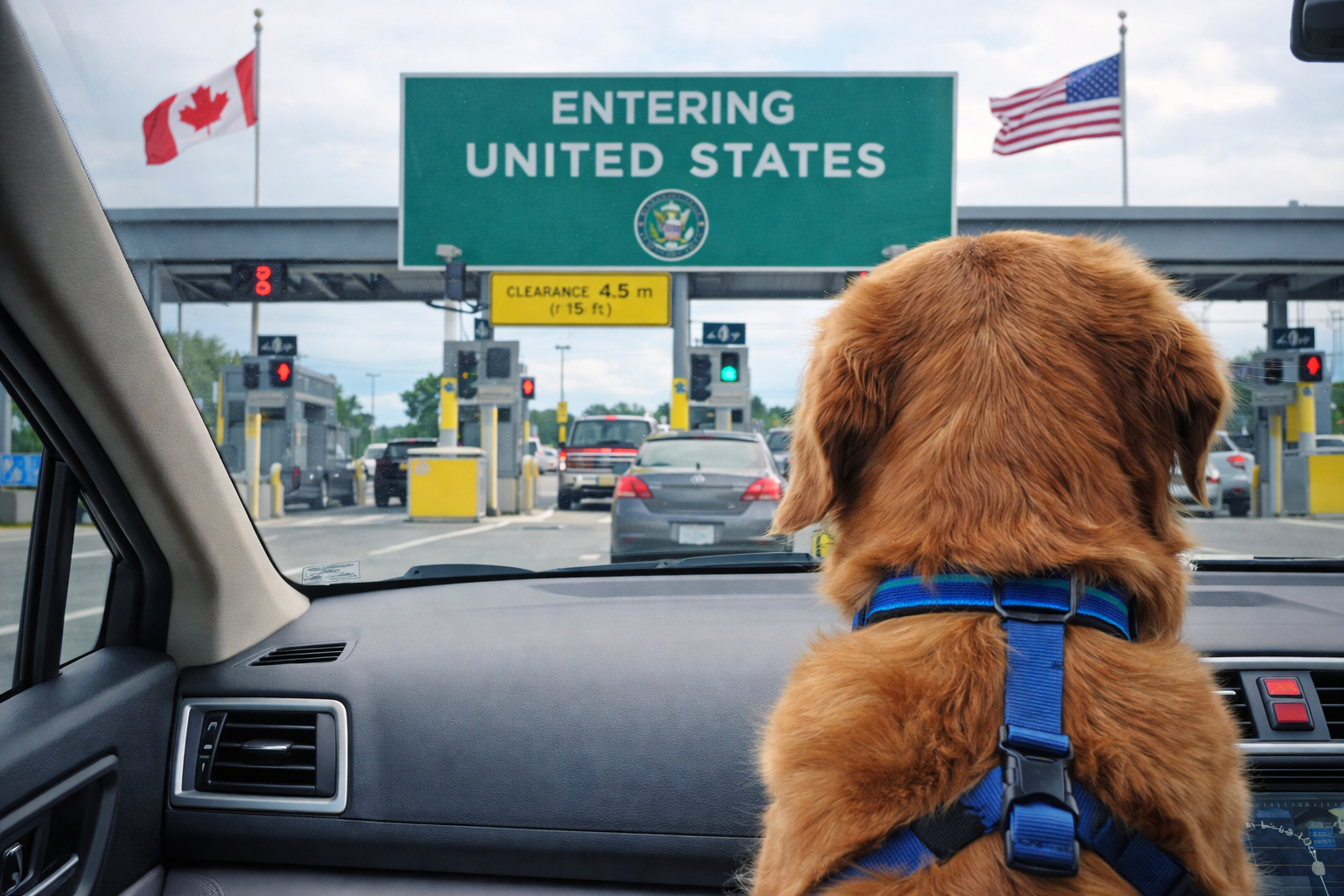
When you arrive at the U.S. border, officers might:
- Check your paperwork (CDC form receipt, proof of age, rabies certificate, vet records)
- Look at your dog to confirm they appear healthy
- Scan the microchip and verify it matches your documents
- Ask where your dog has been in the last six months
Border officers can refuse entry or take enforcement action if dogs aren’t properly documented, appear sick, or aren’t being transported humanely.
Make it easier on yourself
- Keep your dog safely restrained in the car
- Organize documents in a folder (and keep digital backups)
- Budget extra time in case you’re sent to secondary inspection
- Check requirements before every trip (rules have changed multiple times since 2021)
Once you’ve done it once, it gets easier. Your dog doesn’t care about the paperwork—they’re just excited for the adventure with you.
Step 5: Getting Back Into Canada
Your trip isn’t over until you’re legally back in Canada with your pup.
Canada generally requires a valid rabies vaccination certificate for dogs 3 months or older entering from the U.S. Officers can check documents and may inspect animals that are undeclared, improperly documented, sick, or not humanely transported.
The good news: the same rabies certificate you used for the U.S. should work for coming home, as long as it’s still valid.
Checklist for Taking Your Dog from Canada to the U.S.
1–2 months before
- Confirm your dog is at least 6 months old
- Confirm your dog has only been in low-risk countries
- Make sure your dog has an ISO-compliant microchip in their vet records
2–4 weeks before
- Have your vet scan and confirm the microchip is readable
- Get or update your rabies certificate (microchip number included)
- Get a health certificate or recent vet record
- Gather 6–12 months of vet records with the microchip number
A few days before
- Complete the CDC Dog Import Form online
- Print the receipt and save it on your phone
Day of travel
- Transport your dog safely and humanely
- Have ready: CDC form receipt, rabies certificate, health certificate, vet records
- Prepare for inspection and possible microchip scanning
Coming home
- Declare your dog to Canadian border services
- Show your rabies certificate
- Be ready for possible inspection fees
Special Cases (Probably Not You, But Just in Case)
This guide is for personal pets with simple travel histories. If your situation is different, the rules get complicated fast:
- If your dog visited a high-risk rabies country recently: entry may not be allowed at land borders and you may need to fly into specific airports with additional requirements.
- If you’re bringing a dog for resale, adoption, or rescue: that can be considered commercial movement and may involve separate USDA rules on top of CDC rules.
And yes—you should declare your dog when you return.
Frequently Asked Questions (Canada to U.S. With a Dog)
1) Do I need the CDC Dog Import Form for a day trip from Canada to the U.S.?
Yes. Even for a day trip, you should complete the CDC Dog Import Form and keep the receipt available.
2) How early can I submit the CDC Dog Import Form?
You can submit it up to six months in advance, and no later than the day before arrival.
3) Is the CDC Dog Import Form receipt valid for multiple entries?
For dogs traveling only from low-risk countries like Canada, the receipt may be valid for multiple entries over six months, provided no high-risk travel occurs.
4) How old does my dog need to be to enter the U.S.?
Your dog must be at least six months old.
5) Does my dog need a microchip to cross the U.S. border?
Yes. Your dog must have an ISO-compliant microchip (ISO 11784/11785, 15-digit) or a chip readable by a universal scanner.
6) Do dogs from Canada need a rabies certificate to enter the U.S.?
Requirements can vary depending on travel history and state-level rules. Even when federal requirements are simplified for low-risk entries, carrying a rabies certificate is strongly recommended for practical reasons and for returning to Canada.
7) What happens if my dog doesn’t look healthy at the border?
Dogs must appear healthy upon arrival. If an officer has concerns, you may be asked for veterinary documentation or additional information, and entry could be denied.
8) What do I need to bring my dog back into Canada from the U.S.?
Canada generally requires a valid rabies vaccination certificate for dogs three months or older returning from the United States.